Pakistan: Potato Output Up 168% Since 2010 to 8.43 Mt, Mostly in Punjab

Prìomh takeaways
- 8.43 Mt of potatoes produced in Pakistan in 2024 (FAOSTAT)
- 168% growth in Pakistani potato output from 2010 to 2024
- 24.9 t/ha average Pakistani potato yield in 2024, FAOSTAT
- 97% of Pakistani potato output grown in Punjab, per source
Carson a tha e cudromach
- Airson luchd-giullachd
- Secure contracted supply of processing varieties early; rapid area growth has been mainly in table potatoes, not in industry-grade crops.
- Do luchd-malairt
- Plan export programmes for years of large Punjab harvests, when domestic prices fall below cost; Central Asia and the Gulf are the nearest outlets.
- Do sholaraichean
- Position certified seed for the autumn plains crop in Punjab, which carries most of the national volume and the highest demand for imported seed.
- Airson luchd-tasgaidh
- Look at cold storage and grading capacity in Okara, Sahiwal and Kasur, where output is concentrated and storage shortages drive harvest-time selling.
Geàrr-chunntas 60-diog
Few large potato producers have expanded as fast as Pakistan. FAOSTAT shows 8.43 million tonnes in 2024 against 3.14 million in 2010, a rise of about 168 percent, while India grew by roughly 56 percent and Bangladesh by about a third. Yield is close to its neighbours at 24.9 tonnes per hectare, so most of the gain came from more land, around 339,000 hectares in 2024. Supply is highly concentrated: Punjab grows over 97 percent of the crop, centred on Okara, Sahiwal and Kasur. Large harvests can exceed domestic demand, so cold stores, grading capacity and exports decide how the crop is marketed. Seed exporters, storage builders, processors and regional traders are the groups most affected. The caveat is that the Punjab share comes from an industry aggregator rather than an official source, and seed import volumes were not available for this analysis.
Pakistan produced 8.43 million tonnes of potatoes in 2024, according to FAOSTAT. In 2010 the country produced 3.14 million tonnes. Output grew by about 168% in 14 years.
That is one of the fastest expansions among large producers. Over the same period, FAOSTAT shows India rising from 36.6 to 57.1 million tonnes, about 56%. Bangladesh grew from 7.9 to 10.6 million tonnes, about 34%.
The average Pakistani yield in 2024 was 24.9 t/ha, according to FAOSTAT. That implies a harvested area of roughly 339,000 hectares. The yield is close to India at 24.6 t/ha and Bangladesh at 23.2 t/ha. It is still about half the 50.9 t/ha that FAOSTAT records for the United States in 2024.
Làithean na seachdain. Dì-chlàraich le aon bhriogadh.
One province, several seasons
Punjab dominates. According to PotatoPro, Punjab grows more than 97% of national output. The main clusters are Okara, Sahiwal, Kasur, Pakpattan, Multan, Khanewal and Vehari.
The plains grow an autumn crop and a smaller spring crop. Highland areas in the north grow a summer crop. According to PotatoPro, this gives a relatively extended supply period. Secondary areas include Chiniot, Jhang, Toba Tek Singh and Faisalabad.
Growth brings price pressure
Rapid expansion makes the market sensitive to each harvest. Area grew much faster than yield. So a large Punjab crop can quickly exceed domestic demand. Growers without access to cold stores must then sell at harvest, when prices are lowest.
According to PotatoPro, production depends on cold storage, grading, washing and packing capacity. These links decide how long the crop can be marketed. Varieties used for table and industry include: Sante, Santana, Asterix, Lady Rosetta.
Research has a long history. According to PotatoPro, systematic potato research began around 1931. A federal potato research station opened at Murree in 1958–59.
Carson a tha e cudromach
On FAOSTAT data, Pakistan is now the fourth-largest potato producer in Asia, after China, India and Bangladesh. In good years the crop can outgrow the domestic market. Exports and storage are then the main outlets. For seed exporters, storage builders and processors, Pakistan is now a volume market. But the concentration in one province means one bad season in Punjab moves the national price.
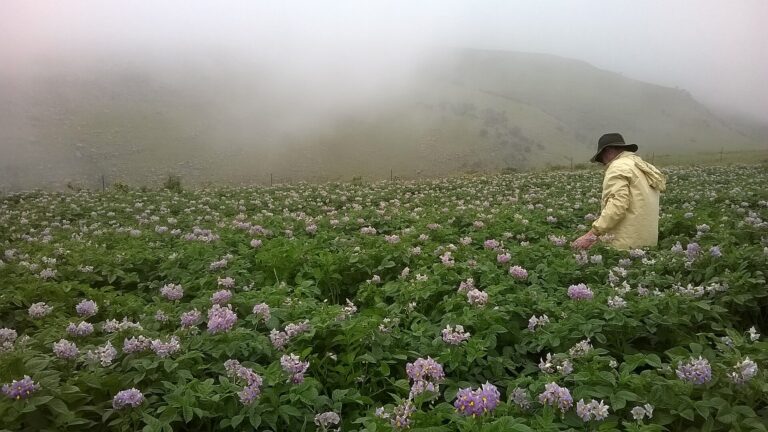
Photo: Potato fields in Batakundi, Khyber Pakhtunkhwa, Pakistan (illustrative). Faran104 / Wikimedia Commons, CC BY-SA 4.0
Geàrr-chunntas Buntàta Cruinneil
Còig prìomh sgeulachdan, prìsean, rabhaidhean galair agus tachartasan. Madainnean làithean seachdaineach, gun sanasachd.
Dè a-nis
FAOSTAT 2025 data will show whether expansion continues. The size of the next Punjab autumn crop will decide pressure on prices and cold stores.
stòran
- FAOSTAT, Bàrr agus toraidhean sprèidh (QCL) — https://www.fao.org/faostat/en/#data/QCL
- An Saoghal againn ann an Dàta, cinneasachadh buntàta (dàta FAOSTAT) — https://ourworldindata.org/grapher/potato-production
- An Saoghal againn ann an Dàta, toradh buntàta (dàta FAOSTAT) — https://ourworldindata.org/grapher/potato-yields
- PotatoPro, Pakistan potato market — https://www.potatopro.com/potato-markets/pakistan
- ODINN ISTOCHNIK
Ceangailte san stuth seo
- dùthaich
- Pacastan
- Earrannan
- ÀisiaNaidheachdan- HUASHIL
Sgeulachdan co-cheangailte
An Tuirc: Bidh Institiùd Niğde a’ buain mion-thubairean sàr-mhath bho shiostam hydroponic

Belarus: Ràinig fogharadh buntàta 43% den phlana fhad ’s a bha luchd-fàs a’ cladhach 317,000 tunna